
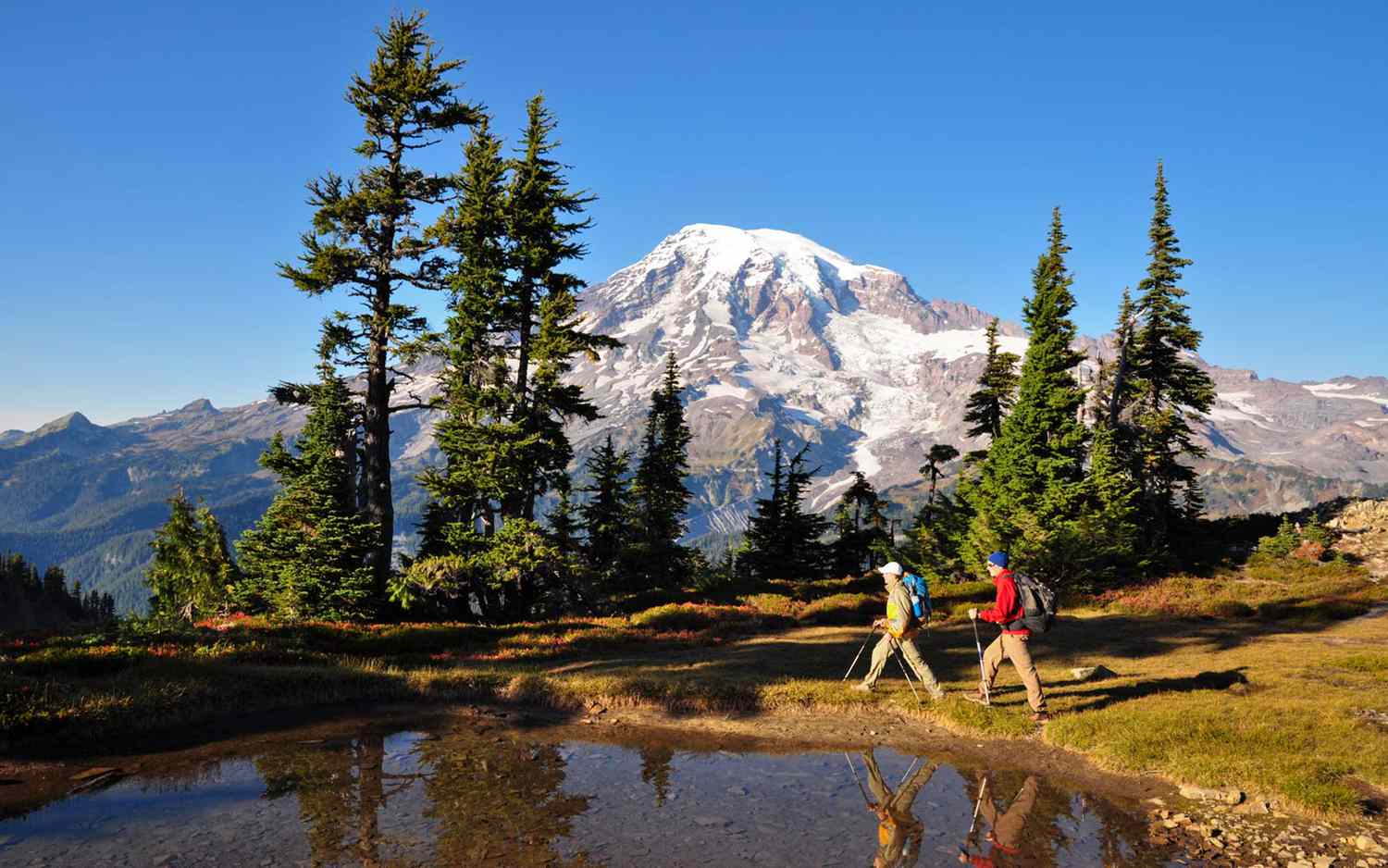
Best states for spring hiking in the U.S.
Spring hiking season is when millions of Americans head outdoors to enjoy blooming landscapes, fresh mountain air, and longer days on the trail. But not every state offers the same hiking experience. Some are packed with thousands of scenic routes and dramatic elevation changes, while others have fewer trails and flatter terrain.

To uncover the best states for spring hiking, RVezy analyzed eight hiking-related factors across the country. These included trail density, elevation gain, trail length, air quality, spring weather conditions, rainfall levels, trail popularity through reviews, and pollen levels.
Top 5 states for spring hiking
1. California
California ranks first thanks to its enormous hiking infrastructure. The state leads the nation in trail density, elevation gain, and total trail miles, offering everything from coastal trails to alpine mountain routes. With more than 18,000 miles of trails and comfortable spring weather, it delivers one of the most diverse hiking experiences in the country.
2. Washington
Washington’s pristine landscapes and clean air help secure its second-place ranking. The state has one of the largest trail networks in the U.S. and some of the best air quality conditions, making it an excellent destination for hikers seeking dramatic scenery and fresh mountain environments.
3. Colorado
Colorado is a dream destination for hikers looking for elevation and adventure. Ranking near the top for elevation gain and trail length, the state offers challenging mountain hikes and extremely popular routes, reflected in its high number of trail reviews.
4. Utah
Utah’s red rock landscapes and national parks provide some of the most visually striking hiking terrain in the country. Strong rankings for elevation gain and trail popularity help the state secure a place among the best spring hiking destinations.
5. Wyoming
Wyoming offers some of the cleanest air in the country along with rugged mountain terrain. While its trail network is smaller than some states, the dramatic landscapes and remote wilderness areas make it a favorite among hikers seeking untouched natural beauty.
Bottom 5 states for spring hiking
1. Mississippi
Mississippi ranks last due to its limited trail network and relatively small elevation changes. The state also records very few trail reviews, suggesting fewer widely recognized hiking destinations.
2. Arkansas
Arkansas struggles with higher pollen levels and weaker air quality scores compared to top-ranking states. Its trail system is also relatively small, which reduces overall hiking opportunities.
3. Louisiana
Louisiana has one of the lowest total trail mileages in the country and minimal elevation gain, making it less appealing for hikers seeking varied terrain and scenic climbs.
4. Indiana
Indiana’s relatively flat terrain and modest trail system limit its appeal for hikers looking for dramatic landscapes or longer backcountry routes.
5. Iowa
Iowa performs slightly better than some states for trail mileage but still ranks near the bottom due to lower trail popularity and limited elevation changes compared to more mountainous regions.
Michael McNaught, a spokesperson for RVezy, commented on the study:
“Spring is easily one of the most rewarding times of the year to go hiking. The trails start to come alive again, wildlife becomes more active, and you get that perfect balance where it’s not too hot but not freezing either. Many hikers love spring because it feels like the outdoors is waking up with you. Flowers start blooming, waterfalls are stronger from snowmelt, and the scenery changes almost week by week.”
“For people planning spring hikes, I always recommend checking trail conditions and weather before heading out. Snow can still linger in higher elevations, and spring rain can make some trails muddy. A good tip is to start with shorter hikes early in the season, especially if you haven’t been active during winter. Build up gradually, bring extra water, and always have layers since spring weather can change quickly.”
The full ranking:
| Rank | State | Trail Density (trails per 100 sq miles) | Maximum Elevation Gain (feet) | Total Trail Length (miles) | Air Quality Index | Average Spring Temperature (°F) | Average Spring Precipitation (inches) | Reviews per Trail | Adjusted Pollen Allergy Index | Total Score |
| 1 | California | 10.47 | 14,494 | 18,467 | 7.24 | 57.1 | 1.93 | 401.94 | 8.48 | 62.70 |
| 2 | Washington | 8.23 | 14,411 | 10,590 | 4.86 | 47.7 | 2.9 | 387.53 | 6.42 | 57.28 |
| 3 | Colorado | 5.81 | 14,433 | 11,516 | 5.09 | 43.7 | 1.56 | 507.93 | 8.93 | 56.86 |
| 4 | Utah | 4.35 | 13,528 | 5,478 | 5.52 | 47.5 | 1.16 | 473.35 | 6.77 | 52.83 |
| 5 | Wyoming | 1.14 | 13,804 | 4,102 | 3.08 | 40.8 | 1.42 | 224.89 | 7.15 | 51.04 |
| 6 | Arizona | 3.03 | 12,637 | 6,540 | 8.13 | 58.2 | 0.77 | 634.64 | 9.47 | 49.47 |
| 7 | Massachusetts | 55.31 | 3,489 | 5,752 | 5.64 | 45.7 | 4.06 | 219.64 | 5.94 | 49.26 |
| 8 | Oregon | 4.01 | 11,239 | 7,652 | 4.96 | 46.9 | 2.33 | 275.51 | 5.98 | 48.91 |
| 9 | Nevada | 1.04 | 13,140 | 1,964 | 4.99 | 48 | 0.96 | 322.81 | 9.07 | 46.51 |
| 10 | Montana | 1.13 | 12,799 | 2,176 | 5.4 | 42.5 | 1.51 | 286.17 | 5.88 | 45.01 |
| 11 | New Hampshire | 27.21 | 6,288 | 2,085 | 4.88 | 42.4 | 3.54 | 338.74 | 5.22 | 43.33 |
| 12 | Idaho | 1.93 | 12,662 | 2,854 | 5.79 | 43.6 | 1.75 | 160.53 | 7.28 | 42.30 |
| 13 | Connecticut | 50.74 | 2,380 | 2,036 | 6.06 | 47.3 | 4.35 | 238.22 | 5.97 | 42.14 |
| 14 | Rhode Island | 51.26 | 812 | 519 | 5.53 | 47 | 4.23 | 286.75 | 6.07 | 40.51 |
| 15 | New Mexico | 1.39 | 13,161 | 5,237 | 9.8 | 52.4 | 0.82 | 235.51 | 9.22 | 39.58 |
| 16 | New York | 11.31 | 5,344 | 4,447 | 6.37 | 43.6 | 3.41 | 296.66 | 6.06 | 34.39 |
| 17 | Maine | 8.21 | 5,268 | 4,490 | 5.25 | 39.1 | 3.49 | 223.45 | 4.98 | 34.35 |
| 18 | North Carolina | 6.6 | 6,684 | 2,634 | 7.15 | 58.2 | 4.14 | 352.69 | 7.23 | 34.09 |
| 19 | Virginia | 6.35 | 5,729 | 3,194 | 6.35 | 54.1 | 3.91 | 335.42 | 7.04 | 34.02 |
| 20 | New Jersey | 27.13 | 1,803 | 1,494 | 6.11 | 50.6 | 4.13 | 315.82 | 6.38 | 34.00 |
| 21 | Vermont | 11.07 | 4,393 | 1,525 | 4.75 | 41.5 | 3.4 | 217.53 | 4.82 | 33.87 |
| 22 | Maryland | 15.26 | 3,360 | 1,975 | 6.2 | 52.8 | 3.93 | 382.77 | 6.67 | 33.53 |
| 23 | South Dakota | 0.63 | 7,242 | 424 | 6.8 | 44.8 | 2.17 | 264.79 | 5.49 | 32.04 |
| 24 | Texas | 1.26 | 8,751 | 3,170 | 9.91 | 65.1 | 2.5 | 255.96 | 9.92 | 31.67 |
| 25 | Tennessee | 4.92 | 6,643 | 1,262 | 6.96 | 57.3 | 5.15 | 349.30 | 6.83 | 30.73 |
| 26 | Pennsylvania | 9.03 | 3,213 | 4,840 | 7.26 | 47.4 | 3.67 | 244.15 | 6.22 | 29.02 |
| 27 | Nebraska | 0.47 | 5,424 | 393 | 6.38 | 48.2 | 2.6 | 113.63 | 7.22 | 27.65 |
| 28 | Georgia | 3.24 | 4,784 | 2,152 | 9.14 | 63.1 | 4.16 | 382.64 | 7.61 | 26.89 |
| 29 | West Virginia | 4.3 | 4,863 | 1,163 | 7.32 | 50.9 | 4.06 | 188.01 | 5.71 | 26.80 |
| 30 | Minnesota | 2.15 | 2,301 | 3,238 | 6.94 | 41.9 | 2.19 | 184.27 | 5.34 | 26.06 |
| 31 | Kentucky | 2.81 | 4,145 | 364 | 6.85 | 55.1 | 4.61 | 246.16 | 6.83 | 25.39 |
| 32 | Florida | 5.7 | 345 | 2,670 | 7.84 | 69.9 | 3.63 | 159.34 | 8.45 | 25.32 |
| 33 | Delaware | 12.37 | 448 | 215 | 6.83 | 53.3 | 4.01 | 292.76 | 6.42 | 24.97 |
| 34 | Kansas | 0.78 | 4,039 | 547 | 7.35 | 53.6 | 3 | 109.00 | 7.01 | 24.91 |
| 35 | South Carolina | 3.08 | 3,560 | 827 | 8.27 | 62 | 3.83 | 252.73 | 8.18 | 24.56 |
| 36 | North Dakota | 0.35 | 3,506 | 200 | 6.89 | 41.1 | 1.5 | 100.34 | 5.94 | 24.55 |
| 37 | Wisconsin | 3.59 | 1,951 | 2,872 | 7.05 | 42.9 | 2.73 | 157.88 | 5.84 | 24.10 |
| 38 | Michigan | 4.77 | 1,979 | 3,588 | 7.59 | 42.6 | 2.62 | 194.09 | 6.21 | 24.08 |
| 39 | Oklahoma | 0.93 | 4,973 | 502 | 7.62 | 59.1 | 3.84 | 230.01 | 10.35 | 23.81 |
| 40 | Missouri | 2.45 | 1,772 | 1,703 | 6.92 | 54.4 | 4.12 | 241.78 | 7.66 | 22.81 |
| 41 | Ohio | 6.81 | 1,550 | 1,528 | 7.95 | 49.7 | 3.53 | 264.39 | 6.28 | 22.78 |
| 42 | Illinois | 3.73 | 1,235 | 1,749 | 7.91 | 51.6 | 3.79 | 182.20 | 6.03 | 21.08 |
| 43 | Alabama | 2.06 | 2,413 | 1,042 | 7.63 | 62.5 | 5.37 | 180.51 | 7.68 | 21.05 |
| 44 | Iowa | 1.74 | 1,670 | 1,697 | 7.26 | 48.2 | 3.25 | 89.09 | 6.61 | 20.98 |
| 45 | Indiana | 3.96 | 1,257 | 738 | 7.85 | 51.1 | 3.94 | 207.52 | 6.70 | 19.65 |
| 46 | Louisiana | 0.87 | 535 | 181 | 7.49 | 66.3 | 5.22 | 90.92 | 7.88 | 18.11 |
| 47 | Arkansas | 2.07 | 2,753 | 633 | 8.72 | 60.3 | 4.99 | 220.42 | 9.52 | 17.53 |
| 48 | Mississippi | 0.69 | 807 | 337 | 7.91 | 63.2 | 5.77 | 70.93 | 7.65 | 15.57 |
Methodology
The study ranked U.S. states based on key hiking factors to show where trails really shine in spring. Metrics included trail density (20%), maximum elevation gain (20%), total trail length (15%), air quality index (15%), average spring temperature (10%), average spring precipitation (10%), reviews per trail (5%), and an adjusted pollen allergy index (5%). Each state received a total score based on these measures to highlight the best and least favorable places for hikers.
Sources: AllTrails, Current Results, Destination Hikers, AirNow, pollen.com